Acropora sarmentosa
Taxonomical systematics
Scientific name
Acropora (Acropora) sarmentosa (Brook, 1892)
Synonyms
Madrepora sarmentosa Brook, 1892
Acropora vermiculata Nemenzo, 1967
Common names
Acropora,
Subgenus
Acropora Oken, 1815
Genus
Acropora Oken, 1815
Family
Acroporidae Verrill, 1902
Suborder
Astrocoeniina Vaughan and Wells, 1943
Order
Scleractinia
Subclass
Zoantharia
Class
Anthozoa
Phylum
Cnidaria
Phylogeny
Closest sibling
Acropora (Acropora) florida (Dana, 1846) (Wallace, 1999)
Species group
florida group (Wallace, 1999)
Clade
SFAHL clade (C) (Wallace, 1999)
Clade origination
SFAHL clade (C) origination appears to coincide with the isolation of the Indo-Pacific Tethys from the Caribbean Tethys after early to mid-Miocene (Wallace, 1999)
Geological history
Fossil record
None
Local ecology
Distribution
Tropical Western Pacific Ocean, Great Barrier Reef, Tropical Eastern Indian Ocean.
Habitat
Shallow exposed upper reef slopes (Veron and Wallace, 1984). Subtidally on reeftops and slopes (Wallace, 1999). Upper reef slopes and lagoons (Veron, 2000).
Biological characteristics
Description
Lobed or cushion-like colonies. Main branches are prostrate. Secondary branches are bottlebrush-like. Dull greenish-grey or brown with pale brown or orange branch tips (Veron, 2000).
Polyps have 12 tentacles, 6 entocoelic and 6 exocoelic. The tentacle above the directive septum is elongated. The gastrovascular cavity contains 12 mesentries arranged in 6 bilateral pairs. Pairs 3 and 4 are directive and pairs 5 and 6 are incomplete. (Wallace, 1999).
Captive colony showed strong fluorescence. Captive colonies have tentacles extended during the day.
Zooxanthellate
Hermatypic
Associated organisms
Zooxanthellae: dinoflagellate symbionts of the genus Symbiodinium, most likely clade C (Wallace, 1999).
Crabs of the genera Tetralia and Tetraloides (Wallace, 1999).
Shrimps of the genera Coralliocaris, Jocaste, Philarius and Periclimenes (Wallace, 1999).
Barnacles, small fish (e.g. Gobiodon, gastropods and bivalves (Wallace, 1999).
Additionally, coral-feeding such as Chaetodon may feed on the polyps (Wallace, 1999).
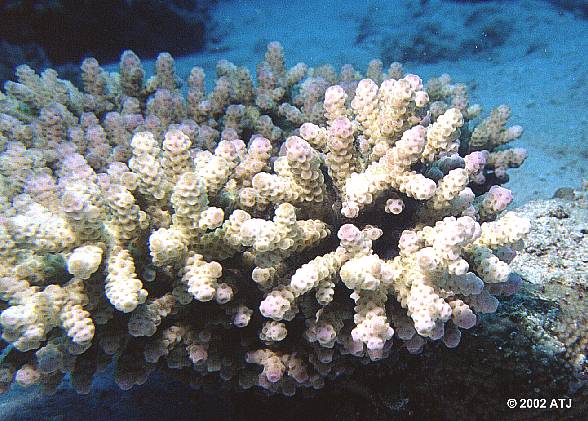
Acropora sarmentosa colony at Cod Hole, Ribbon Reef #10, Queensland, Australia.
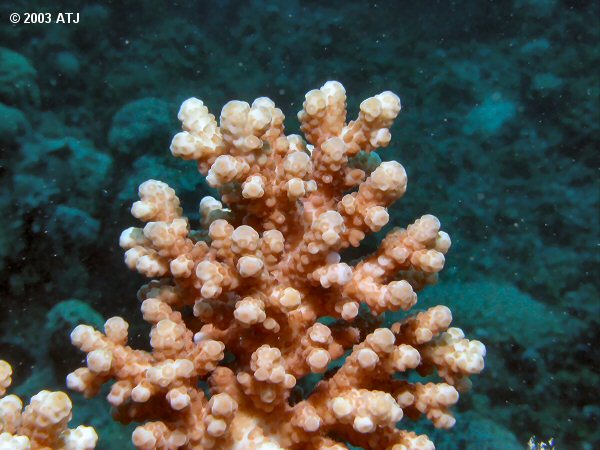
A. sarmentosa colony at Osprey Reef in the Coral Sea.

A. sarmentosa colony at Eagle Rock, Ribbon Reef #10, Queensland, Australia.
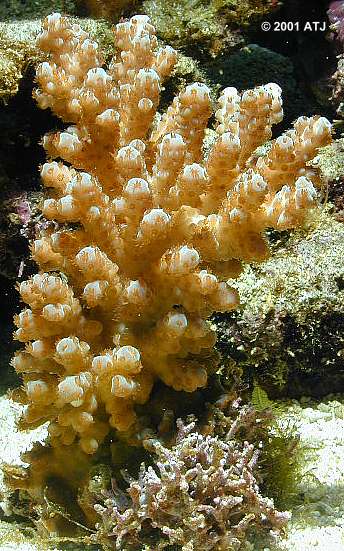
A. sarmentosa in the aquarium.
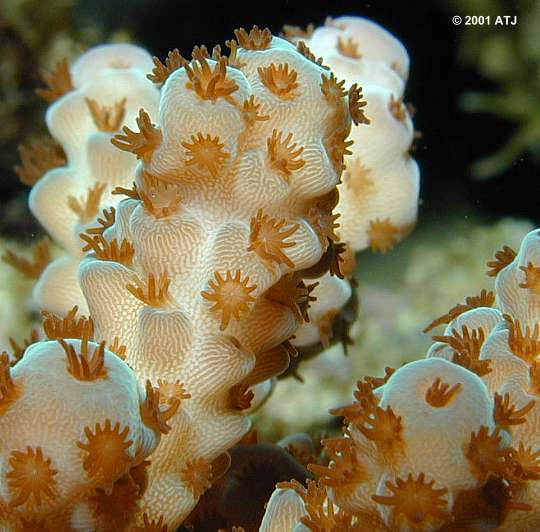
Close-up of A. sarmentosa in the aquarium showing corallites with tentacles extended.
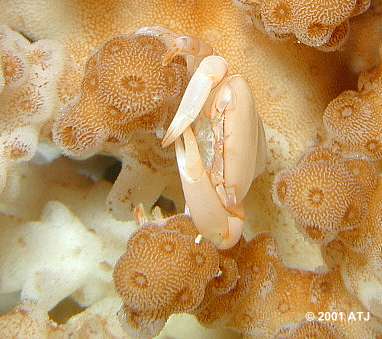
Crab (probably Tetralia sp.) in branches. Note this is the actually the discarded exoskeleton of the crab.
Skeletal structure
Corallum
Hispidose to corymbose. One or two branching units (sometimes more). Main branch usually horizontal or oblique, up to 30 mm in diameter. Branchlets are 6-12 mm in diameter and up to 25 mm in length. In deeper water, the branches may be flattened with branchlets only on upper surface. Growth determinate, or almost so (Wallace, 1999).
Corallites
Axial corallites large and rounded, 3.0-4.0 mm in diameter with calices 1.0-2.0 mm in diameter. Primary septa present up to 3/4 R, secondary septa present up to 1/2 R. Radial corallites 2.6-3.6 mm in diameter with round calices 2.1-2.8 mm in diameter, just touching or slightly separated on branch, tubular appressed. Primary septa present up to 2/3 R, secondary septa present up to 1/4 R. (Veron and Wallace, 1984; Wallace, 1999)
Coenosteum
A dense reticulum with spinules that are laterally flattened or slightly elaborated evenly and sparsely distributed. (Wallace, 1999)
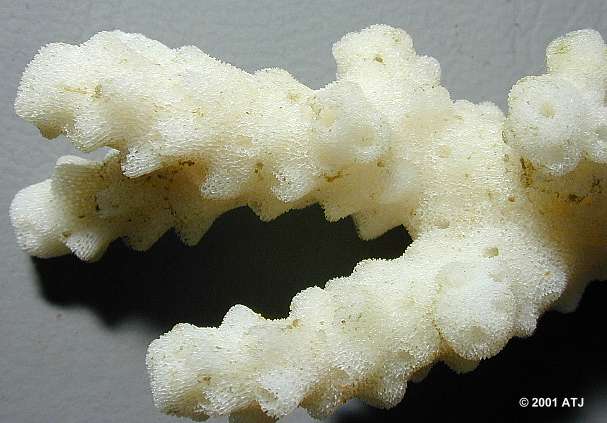
Acropora sarmentosa skeleton.
Captive care
Lighting
Intense (based on shallow habitat)
Water flow
High with turbulence and/or surges (based on exposed habitat)
Feeding
Zooplankton (e.g. Copepods, Artemia nauplii), particulate organic matter (e.g. finely grated shrimp or mussel meat)
Growth rate
No specific numbers available. Subjective observations suggest the growth rate is medium to fast under ideal conditions.
Diseases and other maladies
"Black band disease" had been reported from A. sarmentosa on the Great Barrier Reef (Dinsdale, 1994 in Wallace, 1999).
"White band disease" has not so far been reported in A. sarmentosa not from the Great Barrier Reef, but has been reported for several species in the Philippines (Wallace, 1999)
Other maladies may be possible including: Shut-down reaction (SDR), which may be the same as Rapid Tissue Degeneration (RTD) and Bleaching.
I have personally lost a colony to SDR/RTD.
Reproduction
Sexual reproduction mode
Broadcast spawner (Wallace, 1999)
Sexes
Hermaphrodite (Wallace, 1999)
Asexual methods
Fragmentation due to storms and other physical disturbances neither frequent nor infrequent (Wallace, 1999). Fragments can be propagated.
References
Veron J.E.N. 2000. Corals of the World - Volumes 1, 2, 3. Australian Institute of Marine Science, Townsville, Australia. 1382pp.
Veron J.E.N. and Wallace C.C. 1984. Scleractinia of Eastern Australia. Part 5 Family Acroporidae. Australian Inst Mar Sci Monogr Ser VI:, . 485pp.
Wallace C.C. 1999. Staghorn Corals of the World : A Revision of the Coral Genus Acropora. CSIRO, Collingwood, Australia. 420pp.